Aws Administration - The Definitive Guide Free Download UPDATED
Aws Administration - The Definitive Guide Free Download
Chapter 1. Introducing Amazon Web Services
Being in the It manufacture, nosotros all have gone through the long and tedious process of procuring new infrastructure for our data centers at one fourth dimension or some other. Let's be honest, information technology is not a task for the faint-hearted At a minimum, a brand new server can take weeks if not months to go delivered from its date of ordering, and this is too heavily dependent on a lot of external factors which, most of the fourth dimension, are non in our control. Fifty-fifty if the new server comes in on fourth dimension, there is the additional brunt of prepping the rack, clearing space for the new resources, cabling, cooling, mounting, installation of software, configuration, and the list merely keeps on going on for another mile. Putting the server and storage on one side, the same tin can besides use for networking, applications, software, and a whole lot of other things. Simply what if all this was to change? What if tomorrow, you could simply leap kickoff your business concern or scale your application to thousands of servers, all with the elementary click of a button? Seems farfetched, doesn't it, simply in reality, this is possible today with a footling assist from something called as deject calculating.
Cloud computing has definitely evolved a lot over the years, and today it has get almost a mainstream part of our lives. Everything from storing big amounts of data, to having burst compute capacity at your fingertips and having enterprise software applications available on demand any time anywhere are but some of the central benefits that clouds provide today. At the helm of this new fashion of computing is Amazon Web Services ( AWS ).
In this chapter, we are going to look at some of the key features and benefits provided past cloud computing in general forth with few interesting enterprise use cases. Afterward on, you lot will learn a scrap more virtually Amazon Web Services and its core components, and finally have a look at how to sign upward and get started with AWS.
What is deject computing?
Cloud computing has become one of the most discussed topics over the last few years, simply what does it actually mean? Why is it important for you and your business? Allow's have a quick look at what deject computing actually is and how you as an end user tin can benefit from it.
NIST defines cloud computing as a model for enabling ubiquitous, user-friendly, on-demand network access to a shared puddle of configurable computing resources (for example, networks, servers, storage, applications, and services) that tin can be chop-chop provisioned and released with minimal management effort or service provider interaction. Was that a fleck disruptive? Let'due south suspension it downwardly to understand it a little bit better:
-
On demand : Contrary to traditional IT data centers where requesting and obtaining resources for your applications used to take weeks, the same resources can be made available on an on-need basis in the cloud, without requiring any human interventions at all.
-
Network access : I of the key features of whatever deject is that all of its resources can be accessed over the Net or a network in general. This makes it really like shooting fish in a barrel for the cease user to access and leverage cloud from heterogeneous devices such every bit laptops, workstations, mobile phones, and then on.
-
Shared pool : We must have all experienced the silo -based infrastructure setup in our traditional IT data centers. Silos of resources are often created by individual departments where each awarding gets overcommitted resources, which are more ofttimes wasted. In case of the cloud, Information technology resources such as compute, storage, and network are pooled and abstracted together from the end user. This pooling enables the deject to dynamically provide resources to its tenants as and when required without the end user having whatever knowledge of where their application will actually reside in a cluster or a rack.
-
Rapid provisioning : Rapid provisioning or elasticity every bit it is referred to nowadays, is the ability of a cloud to calibration its resource either horizontally (scale out) or vertically (scale up) on an automated basis. This elasticity provides terminate users with a lot of flexibility and control over their resources and how they go consumed.
Deject computing features and benefits
Okay, and then at present we know what cloud computing actually means, only why should yous as an stop user use information technology? How are you and your arrangement going to benefit from it? Let'south wait at some of the key benefits and features deject computing has to offer:
-
Lower costs : Deject computing does not take any upfront costs. Capital expenditure is virtually nil every bit the entire necessary infrastructure and resources are already made available and ready for apply by the Deject provider. All the finish user has to practise is consume these resources and pay only for what they use.
This also reduces the overall maintenance costs as well. Since the organization now has less hardware to manage, it doesn't necessarily take to carp about its server, network, and storage chapters or have a full time staff to manage them.
-
Self-service : Cloud computing provides a elementary, centralized, self-service-based model that end users tin can use to interact with the cloud platform. The interaction tin be in terms of performing simple tasks, such as spinning up new compute resources, adding more storage resources at runtime, or more complex ones, such as scheduling resources and and then on. This ensures that the end user can leverage and consume any of the deject'south resources on an on-need basis.
-
Faster fourth dimension to markets : Unlike traditional It, compute resources can exist brought upwardly in a cloud in a matter of minutes as compared to the weeks it used to take. This provides the cease users with the power to deploy new applications much faster, thus decreasing overall fourth dimension to markets and reducing direction overheads and costs.
-
Scale every bit required: The best office of using the deject is that your backend resources can grow as your application grows. This ways that y'all are never lagging behind with your application's needs and demands, you are always scaling with your application's needs.
Cloud calculating utilize cases
With such features and benefits it is piece of cake to see why at that place has been such a boom in the overall adoption and utilization of the cloud. Permit's have a quick expect at some interesting real-world use cases where your organization tin can leverage clouds:
-
Website hosting : Maybe the most common of the use cases, yous equally an end user can leverage cloud to build and host your websites with relative ease. The cloud enables your website to calibration up and downwards dynamically every bit per its demands.
-
Storage and sharing : The deject offers well-nigh unlimited storage chapters that can used to store and share anything, from documents, media, files, then on. Dropbox and Google Bulldoze are classic examples of deject being used every bit a storage and sharing medium.
-
Disaster recovery (DR) : This is a more upcoming use case with clouds every bit more and more companies are now realizing that information technology is style easier and cost efficient to host a disaster recovery environment on the cloud, rather than hosting and managing a DR site of its own. Organizations can spin upward failover environments on the cloud in a matter of minutes, exam the failover and then shut down the unabridged stack. This helps save on the costs and too reduces overall management overheads and failover time.
-
Dev/exam : Dev and test are way easier to set up and run on clouds as the entire development and test environments can be built up, tested, and torn back down quickly every bit per requirements.
-
Short term projects/ advertising : Like to the Dev/test scenario, the cloud can also exist leveraged to perform a diverseness of short-term projects/proof of concepts. A archetype instance is the advertising campaigns hosted on the cloud that are created for a very short elapsing of time, withal, they need a global presence to reach out to a wider ready of audiences.
-
Big data analytics : Organizations leverage the cloud'southward scalability and on-need infrastructure to capture and perform existent-fourth dimension analytics and information mining on extremely big datasets (large data).
Introducing Amazon Spider web Services
Now, that you clearly understand what cloud computing is all about and what information technology can practice for you lot, let'south become to know the master topic of this book—Amazon Web Services—a fiddling amend.
Amazon Spider web Services or AWS is a comprehensive public cloud computing platform that offers a variety of web-based products and services on an on-need and pay-per-use basis. AWS was before a part of the e-commerce behemothic Amazon.com, and it wasn't until 2006 that AWS became a separate entity of its own. Today, AWS operates globally with data centers located in United states of america, Europe, Brazil, Singapore, Nippon, Communist china, and Australia. AWS provides a multifariousness of mechanisms, using which the end users can connect to and leverage its services, the most mutual form of interaction being the web-based dashboard likewise called as AWS Direction Console.
Then how does the whole thing work? Well, it is very easy to understand when you compare the manner AWS works with a power and utilities company. AWS offers its customers certain services just as a power visitor would to its consumers. You every bit an cease user simply consume the electricity without having to worry about the underlying necessities such as generator costs, cabling, and so on. At the end of the month, all you get is a bill based on your electricity consumption and that'southward it! In a similar manner, AWS provides its products such as compute, storage, and networking all every bit a service, and you merely have to pay for the corporeality of service that you use. No upfront costs or heavy investments any!
The other of import thing worth mentioning here is that AWS allows organizations to use their own operating systems, databases, and programming/architecting models as well, without requiring any major re-applied science. This provides a lot of flexibility and cost optimization to organizations as they get to operate and piece of work with platforms that they are familiar with. This, accompanied with AWS'south massively scalable and highly bachelor infrastructure, ensures that your applications and data remain secure and available for use no affair what.
AWS architecture and components
Earlier nosotros brainstorm with the actual signup process, it is important to take a expect at some of the key architecture and core components of services offered by AWS.
Regions and availability zones
We do know that AWS is spread out globally and has its presence across Usa, Europe, Asia, Australia, and so on. Each of these areas is termed as a region. AWS currently has about 10 regions, each containing multiple data centers within themselves. And so what'south with all these regions and why practice they matter? In simple terms, the resources that are geographically close to your organisation are served much faster! For example, an organization running predominantly from United states can leverage the United states's regions to host their resource and proceeds access to them must faster.
For virtually of the AWS services that you use, you will be prompted to select a region in which yous want to deploy the service. Each region is completely isolated from the other and runs independently besides.
Note
AWS does not replicate resources across regions automatically. Information technology is up to the end user to set up the replication process.
A listing of regions and their respective codes is provided here for your reference. The lawmaking is basically how AWS refers to its multiple regions:
| Region | Name | Code |
|---|---|---|
| Due north America | United states of america East (N. Virginia) | u.s.a.-east-one |
| US W (N. California) | us-west-1 | |
| US West (Oregon) | the states-due west-2 | |
| South America | Sao Paulo | sa-east-1 |
| Europe | EU (Frankfurt) | eu-central-1 |
| EU (Ireland) | eu-westward-1 | |
| Asia | Asia Pacific (Tokyo) | ap-northeast-1 |
| Asia Pacific (Singapore) | ap-southeast-1 | |
| Asia Pacific (Sydney) | ap-southeast-two | |
| Asia Pacific (Beijing) | cn-north-1 |
Each region is separate upward into 1 or more Availability Zones ( AZs ) and pronounced as A-Zees. An A Z is an isolated location inside a region. AZs within a item region connect to other AZs via low-latency links. What do these AZs incorporate? Well, ideally they are made up of i or more physical information centers that host AWS services on them. But equally with regions, even AZs have respective codes to identify them, generally they are regional names followed by a numerical value. For example, if you select and apply united states of america-east-1, which is the North Virginia region, then it would have AZs listed equally united states of america-e-1b, united states of america-east-1c, us-eastward-1d, and and so on:

AZs are very of import from a design and deployment signal of view. Being information centers, they are more than than capable of failure and downtime, then it is always good practice to distribute your resources beyond multiple AZs and blueprint your applications such that they can remain available even if one AZ goes completely offline.
An important point to note here is that AWS volition always provide the services and products to yous as a client; however, it is your duty to design and distribute your applications so that they do not suffer any potential outages or failures.
RULE OF Thumb : Pattern for failure and nothing will fail! This is what we will be sticking with for the remainder of this book as we go along the different AWS services and products; so go on this in listen, always!
Note
AWS provides a health dashboard of all its services running across each of the regions. You lot can view the current condition and availability of each AWS service past visiting the post-obit link: http://status.aws.amazon.com/.
AWS platform overview
The AWS platform consists of a variety of services that you can employ either in isolation or in combination based on your organization's needs. This department will introduce you to some of the near unremarkably used services as well as some newly launched ones. To brainstorm with, permit's split up the services into iii major classes:
-
Foundation services : This is generally the pillars on which the entire AWS infrastructure commonly runs on, including the compute, storage, network, and databases.
-
Application services : This class of services is usually more specific and by and large used in conjunction with the foundation services to add together functionality to your applications. For example, services such as distributed computing, messaging and Media Transcoding, and other services fall under this class.
-
Administration services : This class deals with all aspects of your AWS environment, primarily with identity and admission management tools, monitoring your AWS services and resource, application deployments, and automation.
Let'southward accept a quick look at some of the key services provided past AWS. However, practice note that this is non an exhaustive list:
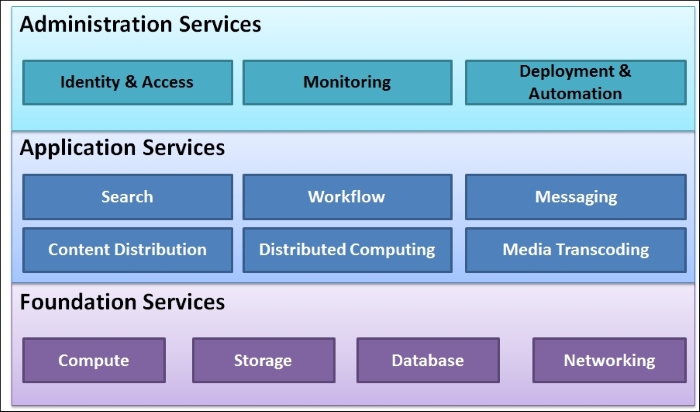
We will discuss each of the foundation services.
Compute
This includes the following services:
-
Rubberband Compute Cloud (EC2) : When information technology comes to fauna computation power and scalability, there must be very few deject providers out in that location in the market that can lucifer AWS'south EC2 service. EC2 or Rubberband Compute Cloud is a spider web service that provides flexible, resizable, and secure compute capacity on an on-need basis. AWS started off with EC2 as one of its core services way dorsum in 2006 and has not stopped bringing changes and expanding the platform ever since. The compute infrastructure runs on a virtualized platform that predominantly consists of the open sourced Xen virtualization engine. We will be exploring EC2 and its subsequent services in detail in the coming chapters.
-
EC2 Container Service : A recently launched service, the EC2 Container Service, allows you to easily run and manage docker containers across a cluster of peculiarly created EC2 instances.
-
Amazon Virtual Private Cloud (VPC) : VPC enables y'all to create secure, fully customizable, and isolated private clouds within AWS's premises. They provide additional security and control than your standard EC2 forth with connectivity options to on premise data centers.
Storage
This includes the following services:
-
Unproblematic Storage Service (S3) : S3 is a highly reliable, fault tolerant, and fully redundant information storage infrastructure provided by AWS. It was i of the first services offered by AWS way back in 2006, and information technology has not stopped growing since. As of April 2013, an approximate 2 trillion objects have been uploaded to S3, and these numbers are growing exponentially each year.
-
Rubberband Block Storage (EBS) : EBS is a raw block device that can be attached to your compute EC2 instances to provide them with persistent storage capabilities.
-
Amazon Glacier : It is a similar service offer to S3. Amazon Glacier offers long-term data storage, archival, and backup services to its customers.
-
Amazon Elastic File Arrangement : Yet another very recent service offering introduced by AWS, Elastic File System ( EFS ) provides scalable and loftier-performance storage to EC2 compute instances in the grade of an NFS filesystem.
Databases
This includes the following services:
-
Amazon Relational Database Service (RDS) : RDS provides a scalable, loftier-functioning relational database organization such as MySQL, SQL Server, PostgreSQL, and Oracle in the deject. RDS is a completely managed solution provided by AWS where all the database heavy lifting work is taken care of by AWS.
-
Amazon DynamoDB : DynamoDB is a highly scalable NoSQL database as a service offering provided past AWS.
-
Amazon Redshift : Amazon Redshift is a data warehouse service that is designed to handle and scale to petabytes of data. It is primarily used by organizations to perform real-time analytics and data mining.
Networking
This includes the post-obit services:
-
Elastic Load Balancer (ELB) : ELB is a dynamic load balancing service provided past AWS used to distribute traffic amidst EC2 instances. You will exist learning about ELB a fleck more than in detail in subsequent chapters.
-
Amazon Road 53 : Road 53 is a highly scalable and available DNS web service provided by AWS. Rather than configuring DNS names and settings for your domain provider, yous can leverage Route 53 to do the heavy lifting work for you.
These are just few of the most unremarkably used AWS foundational services that we listed out here. There are a lot more services and products that you tin leverage to add functionality or utilise to manage your applications. A few of these of import services are briefly described in the side by side department.
Distributed computing and analytics
This includes the following services:
-
Amazon Elastic MapReduce (EMR) : As the name suggests, this service provides users with a highly scalable and easy way to distribute and procedure large amounts of data using Apache'south Hadoop. You can integrate the functionalities of EMR with Amazon S3 to store your large data or with Amazon DynamoDB every bit well.
-
Amazon Redshift : This is a massive data warehouse that users can utilize to store, analyze, and query petabytes of data.
Content distribution and delivery
Amazon CloudFront is basically a content commitment web service that can exist used to distribute various types of content, such as media, files, and so on, with high data transfer speeds to end users globally. You can use CloudFront in conjunction with other AWS services such as EC2 and ELB also.
Workflow and messaging
This includes the following services:
-
Amazon Elementary Notification Service (SNS) : SNS is a simple, fully managed push messaging service provided by AWS. You can use it to push your messages to mobile devices (SMS service) and fifty-fifty to other AWS services equally API calls to trigger or notify certain activities.
-
Amazon Simple Email Service (SES) : As the proper noun suggests, SES is used to send bulk e-mails to various recipients. These east-mails tin can be anything, from simple notifications to transactions letters, and so on. Remember of it as a actually large mail server that can scale as per your requirements and is completely managed by AWS! Awesome, isn't it!
Monitoring
Amazon CloudWatch is a monitoring tool provided past AWS that y'all can use to monitor any and all aspects of your AWS environment, from EC2 instances to your RDS services to the load on your ELBs, and so on. You can even create your own metrics, set thresholds, create alarms, and a whole lot of other activities as well.
Identity and access direction
AWS provides a rich gear up of tools and services to secure and command your infrastructure on the cloud. The almost important and usually used service for this is identity and access management ( IAM ). Using IAM, you tin can, as an organizational ambassador, create and manage users, assign them specific roles and permissions, and manage active directory federations too. Nosotros volition be using a lot of IAM in the next chapter, which covers this topic in greater depth.
Getting started with AWS
Then far, you have learned a lot about AWS, its architecture, and core components. Now, let's get started with the fun role—the signup process.
For all first time users, signing upwards for AWS is a very simple and straightforward process. Nosotros volition go through this shortly, but beginning permit's take a quick wait at something called as a Free Tier! Aye, yous heard it right… FREE!
And then, AWS basically offers usage of certain of its products at no charge for a period of 12 months from the date of the actual signup. A brief list of a few products along with their description is listed here for your reference. Note that some of the description text may not make much sense at present, merely that'due south ok every bit this is just for your reference, and nosotros will be bringing this up from time to fourth dimension equally we progress through the book.
| AWS Production | What's free? |
|---|---|
| Amazon EC2 | 750 hours per calendar month of Linux micro case usage 750 hours per month of Windows micro instance usage |
| Amazon S3 | 5 GB of standard storage 20,000 get requests 2,000 put requests |
| Amazon RDS | 750 Hours of Amazon RDS Single-AZ micro example usage 20 GB of DB Storage: whatever combination of general purpose (SSD) or magnetic twenty GB for backups 10,000,000 I/Os |
| Amazon ELB | 750 hours per month 15 GB of information processing |
Awesome! So when we accept free stuff for usa right from the word get, why wait? Allow'south sign upwardly for AWS. To begin with, launch your favorite web browser and type in the following URL in the address bar: http://aws.amazon.com/.
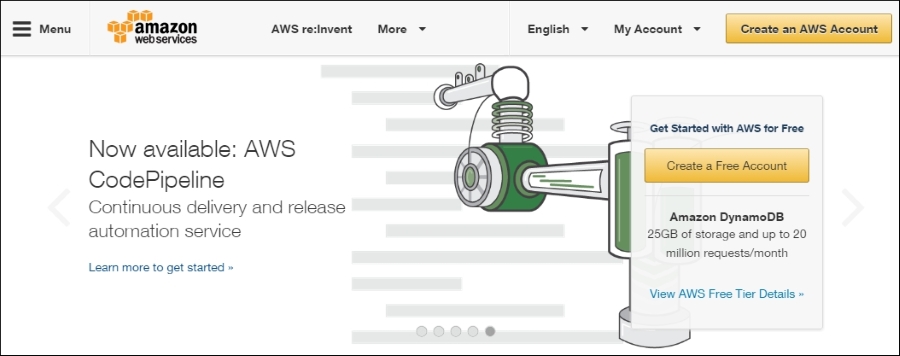
Yous should run across the AWS landing page similar to one shown hither. Here, select either the Create an AWS Account option or the Create a Complimentary Business relationship option to get started:
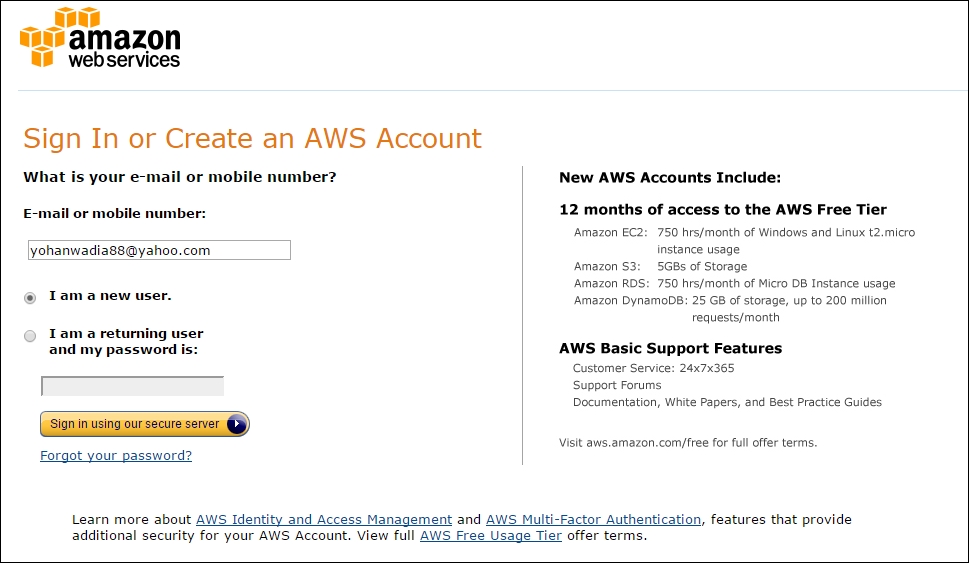
The next screen will assistance you lot with the initial signup process. Provide a suitable east-postal service address or your contact number in the E-mail or mobile number field. Select the I am a new user option and select the Sign in using our secure server push to proceed:
Notation
You lot can alternatively sign in using your Amazon.com credentials too; all the same, its best to utilise separate credentials for working with AWS.
The adjacent couple of screens will exist used to provide your bones details forth with the billing information. In the Login Credentials page, enter your Proper noun , your E-mail accost along with a suitable Countersign . This password will be used by you to login to the AWS Direction Panel, and then ideally provide a strong password here. Click on Create account when done.
The next screen is the Contact Information folio. Provide your Full Proper noun , Company Proper noun , State , Accost , City , Postal Code , and Phone Number equally requested. Check the Amazon Internet Service Pvt. Ltd. Customer Agreement checkbox and select the Create Business relationship and continue options.
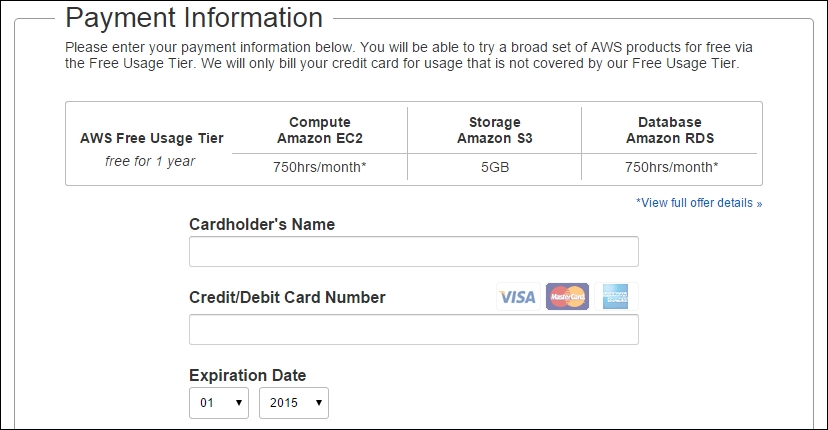
Enter a suitable Cardholder's Proper noun and your Credit/Debit Card Number in the Payment Information folio as shown:
The last function of the signup procedure is the Identity Verification process where you will receive an automated call from AWS as a part of the verification procedure. You will accept to enter the displayed 4 digit PIN lawmaking on your phone's keypad during the call. Once the verification is completed, you can click on the Go on to select your Back up Plan tab:
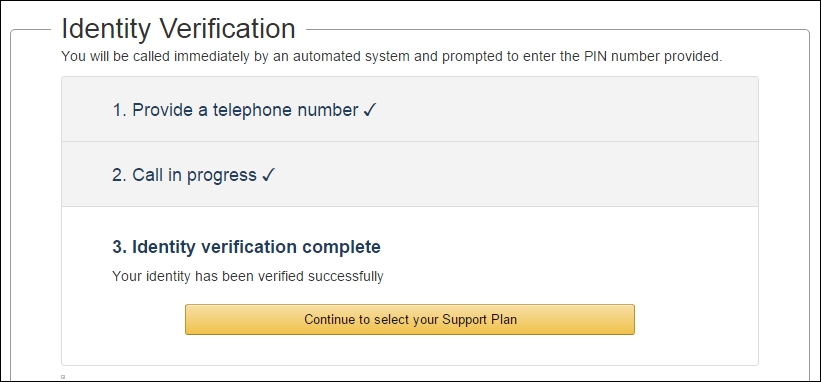
The last step in the signup process involves the pick of the Support Plan. AWS provides four back up options to customers, each having their own SLAs and costs associated with it. Hither is a quick await at the support plans provided by AWS:
-
Basic Back up : As the proper noun suggests, this is the well-nigh basic level of support provided by AWS. This support level provides you with admission to the AWS customs forums. You lot tin additionally contact customer services for any queries related to your account and pecker generation.
Note
The Basic Back up program is free of charge and all customers are entitled to it.
-
Programmer Support : This is a paid support service ($49 per month). You can create and raise tickets for your support case, which is more often than not answered within 12 working hours.
-
Business organization Support : This is a paid support service equally well and is mostly meant for enterprise-level customers running product workloads on AWS. The SLAs for this back up are much higher as a case has to exist answered within an hour from its cosmos. Boosted support is provided 24/seven, 365 days a year via phone and chat.
-
Enterprise Support : A paid back up service with the highest SLA available (15 minutes); these cases are generally handled past a separate team at AWS called the Technical Business relationship Manager ( TAM ) who are subject matter experts in their own fields.
In our instance, we opted to go with Bones Support for the time beingness. Yous tin change the support levels later on as well according to your needs. Click on Continue to complete the signup procedure. Y'all should receive a couple of e-mails on your supplied e-mail address likewise. These are introductory e-mails that volition provide y'all with important links such as how to become started with AWS, billing page, business relationship information, then on.
With these steps completed, you lot are now ready to sign in to the AWS Direction Panel!
Introducing the AWS Direction Console
Then hither we are, all set up to get started with the AWS Direction Console! This is the most usually used method to access, manage, and work with AWS services. We shall be looking more than closely at the different AWS access mechanisms in the side by side chapter; nevertheless for at present, allow's quickly look at what the AWS Management Panel is all about.
Showtime off, sign in to the Management Console by launching your favorite browser and typing in http://aws.amazon.com. Click on the Sign in to the Panel option and provide your Electronic mail Address and password every bit set during our signup process. Once you sign in, you will be welcomed to the AWS Direction Panel main landing page every bit shown here. Wow! That's a lot of products and services, correct? The products are classified into their main classes such as compute, storage and content delivery, assistants and security, and then on then forth. Take a moment and just browse through the dashboard. Get a good feel for information technology.
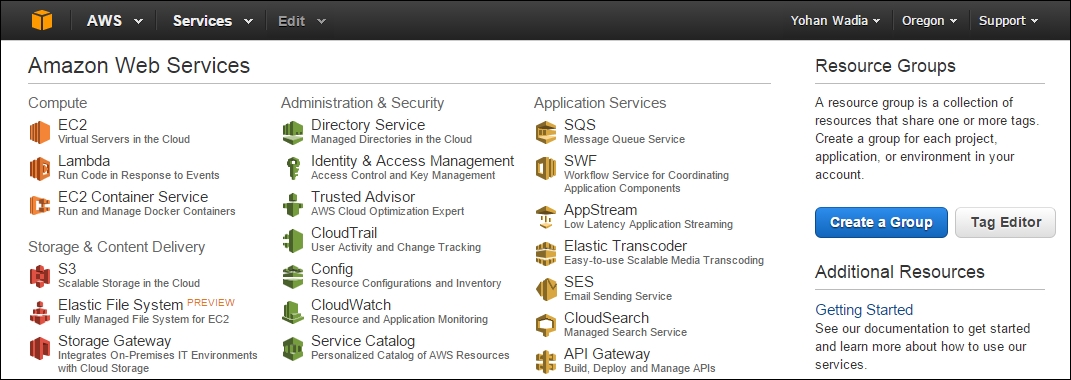
Navigating through the dashboard is also pretty straightforward. Permit'southward look at the acme navigation bar first. To the right-mitt side yous should exist able to see three driblet-down menus. The start should brandish your name as an end user. This option consists of 3 submenus that will assistance you with configuring your account details, security credentials, and billing management. The next tab lists the Region from where you will currently be operating. In our case, we have been placed in the U.s.a. Due west ( Oregon ) region. Call up y'all can modify these regions as and when y'all require, so experience free to modify as per your electric current global presence:

Annotation
The US East (North Virginia) region is the cheapest region in AWS as information technology was 1 of the first regions to get set up and started.
The final tab in the list is the Support tab, and you tin can use it to login to the Support Center , AWS Forums , and view the latest set of AWS Documentation as well. Moving to the left-hand side of the tool bar, you lot will see four main icons listed there. Among these is a Dwelling Screen icon, which when clicked on will bring you dorsum to the AWS dashboard screen irrespective of where you currently are.
The adjacent driblet-down option in the list is named as AWS , but what it really contains is chosen as Resource Groups . These are a collection of AWS resources that tin exist organized and viewed as per your requirements. Think of these resource groups as a customized console where you lot as an cease user tin view all your required information about various AWS services in a single pane. How do resources groups work? Don't worry. We will exist looking into this in more item in the upcoming chapter.
Adjoining the Resource Groups is the Services tab, which lists the AWS services co-ordinate to their class. It also has a history option that can be used to list and view your recently used AWS services.
The final tab is the Edit tab. This tab is used to customize your toolbar by filling it with those AWS services that you apply frequently, kind of like a quick admission bar. To add together a particular AWS service to the toolbar, simply select the AWS service, drag and place it on the toolbar:
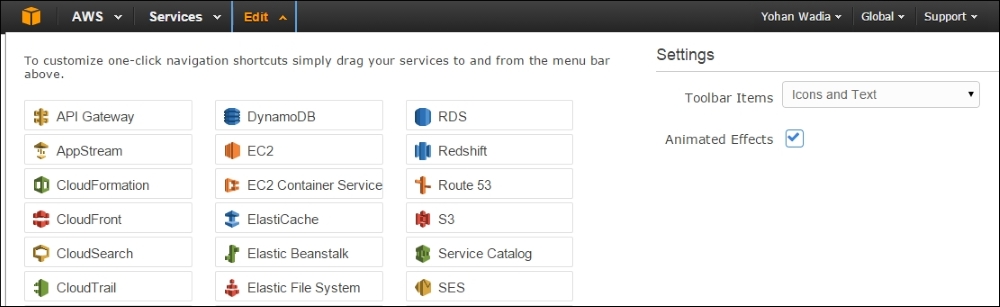
You tin can add together multiple services as yous see fit, and conform them according to your needs every bit well. To save the changes to the toolbar, only select the Edit selection one time again. You should encounter your AWS services listed out on the toolbar now. Feel costless to dig around and check out the various options under each carte.
Getting started with AWS CLI
At present that you have a hang of the AWS Management Console, this would be a good fourth dimension to take a quick look at the AWS CLI as well. Yes, yous heard it right, autonomously from the standard web user interface, AWS provides a host of other mechanisms too to assistance you gain access and use the various AWS resources. Merely why use a CLI in the first place? Isn't the AWS Management Console more than than enough? Well, no. CLIs are more than just uncomplicated access and management tools. Using CLIs, you can automate the deployment and direction of your AWS services using simple code and script, much similar how yous would employ fustigate and beat out scripting. This provides you with a lot of flexibility and customizability that a standard GUI simply won't provide!
The AWS CLI can exist either installed on a Windows or a Linux machine. In case of Windows, AWS provides an easy-to-use installer, which can be downloaded straight from the AWS site. One time downloaded, all you need to do is run the installer, and voila, your Windows server should accept the CLI installed and prepare for utilise. Just I'yard not a Windows guy, and then nosotros will be walking you through the installation procedure on a standard Linux system.
In this case, we volition be installing the AWS CLI on a CentOS half dozen.5 64-scrap OS. The Linux distribution can be anything, from a Debian such equally Ubuntu to a RedHat system; so long as it has Python installed and running off the latest version.
Notation
Python versions supported are Python 2 version two.six.5 and above or Python 3 version 3.3 and above.
You volition also need sudo or root privileges to install and execute the commands, so brand sure you have an appropriate user already created on your Linux system.
The installation of the CLI involves ii major steps; the first involves the installation of Python setuptools, which is a prerequisite of installing Python's pip.
Run the post-obit commands from your Linux concluding:
-
Download the setuptools tar file from the Python source repo:
wget https://pypi.python.org/packages/source/southward/setuptools/setuptools-vii.0.tar.gz
-
Side by side, untar the setuptools installer using the
tarcommand:tar xvf setuptools-7.0.tar.gz
-
Once the contents of the tar file are extracted, change the directory to the
setuptoolsdirectory: -
Finally, run the
setup.pyscript to install the setuptools bundle:
The following is the screenshot of preceding commands of the install process:
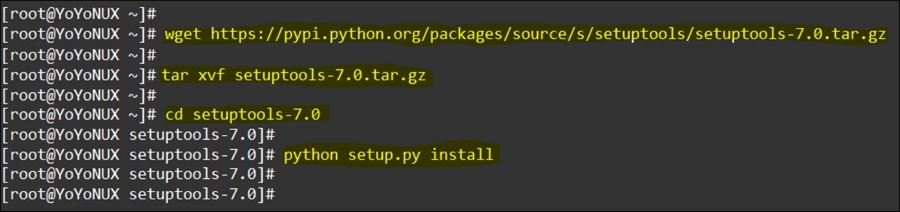
This completes the first part of the install process. The next process is very unproblematic besides. We now install the Python pip parcel. Python pip is by and large recommended when installing Python packages.
Run the following commands from your Linux terminal to install the Python pip package:
-
Download the Python pip installer script from Python's repo:
wget https://bootstrap.pypa.io/get-pip.py
-
Install the pip package:
-
Once pip is installed, you tin at present easily install the AWS CLI by executing the following control:
Refer to the post-obit screenshot showing the output of the installation process:

-
Elementary, wasn't information technology! You can examination your AWS CLI by executing few simple commands, for example, check the AWS CLI version using the following command:
That'south just for starters! At that place is a whole lot more that you can achieve with the AWS CLI, and we will make sure to apply it in each of our chapters, merely to get a expert experience for it.
Plan of assail!
For the purpose of this book, let's assume a simple utilize case in which a hypothetical company called every bit All About Dogs (not the all-time of names I could detect) wants to host and manage their e-commerce website on the cloud. As a part of the hosting, the company would similar to have the following feature fix provided to them by the cloud provider:
-
High availability and error tolerance
-
On-demand scalability
-
Security
-
Reduced management overheads and costs
Here is a simple, traditional architecture of the proposed website, which basically is a two-tier application primarily consisting of spider web servers and a backend database, something most Information technology admins will be familiar with, right? Let's look at the following effigy of tradition spider web service architecture:

This traditional architecture has obvious drawbacks, such equally poor scalability, trivial or no error tolerance, more direction overheads, and and then on. Our goal is to leverage AWS'due south core services and make this obsolete architecture meliorate! Each of the subsequent capacity volition show you how to piece of work with and administrate these core AWS services keeping our utilize instance in mind. By the cease of this volume, you should have a fully scalable, resilient, and secure website hosted on the AWS deject with a design similar to this! Here is the AWS architecture:
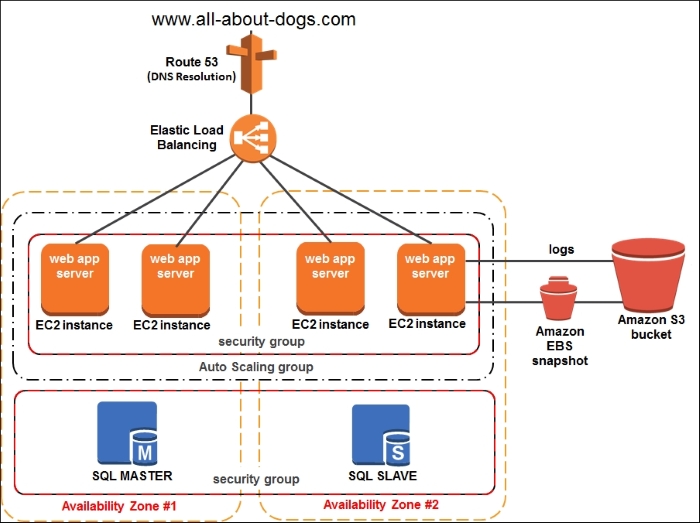
Awesome, isn't it! Believe it or not, this is a bare minimum website hosting architecture on AWS. In that location are still many enhancements and AWS services that you could incorporate hither, only I like to continue things nice and make clean, so this is what we will stick with for the residuum of this book.
Here's a list of AWS products that we volition exist incorporating and primarily learning about throughout the book, apart from few other services:
-
Identity and Access Direction (IAM)
-
Elastic Compute Cloud (EC2)
-
Elastic Container Service (ECS)
-
Elastic Cake Storage (EBS)
-
Amazon Virtual Individual Cloud (VPC)
-
Amazon Cloudwatch
-
Autoscaling and Elastic Load Balancing (ELB)
-
Amazon Relational Database Service (RDS)
-
Amazon Unproblematic Storage Service (S3)
Summary
Let's quickly recap what all we achieved so far in this affiliate. To begin with, you lot learned a bit nearly what cloud computing is all nearly and saw a few features and benefits that it has to offer. Next, we drove straight into our core topic, that is, Amazon Spider web Services. You learned what Amazon Spider web Services is all about by understanding its architecture and core service offer. We then saw how easy and straightforward it is to sign up for AWS along with a cursory walkthrough of the AWS Management Console. Towards the end, you also learned the importance of a command line interface and saw how to install the AWS CLI on a simple Linux server.
In the side by side affiliate, you will learn a flake more than about the CLI and meet how to leverage it to manage and work with the AWS services. We will as well be looking at few piece of cake to utilise access management tools and techniques to safeguard and secure your AWS surround, so stick around! We are just getting started!
DOWNLOAD HERE
Posted by: curleyalary1994.blogspot.com

